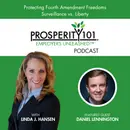
Protecting Fourth Amendment Freedoms – Surveillance vs. Liberty – with Daniel Lennington – [Ep. 295]

 RSS Feed

 iHeartRadio

 TuneIn

 Apple Podcasts

 Spotify

 Overcast

 Castro

 YouTube

 Rumble
There is considerable debate regarding the widespread use of surveillance technologies that monitor and track citizens as they lawfully go about everyday activities. Communities are being forced to reconsider contracts with companies that provide detailed surveillance as citizens have expressed opposition to the constant monitoring without due cause. Many proponents claim the technologies provide a measure of security, but concerned citizens ask at what cost? What are our rights regarding private use of surveillance cameras vs. government use of surveillance cameras? Who owns the data? Who can have access to the data? How can citizens be protected from unreasonable or unwarranted surveillance or searches? What happens when we trade liberty for perceived security? Linda invited Daniel Lennington, Managing Vice President and Deputy Counsel at Wisconsin Institute for Law and Liberty, to discuss the various implications of using surveillance technologies and to learn how we can guard our rights as protected under the Fourth Amendment to the US Constitution. Their enlightening discussion brings clarity to the issue for those who desire to be informed on this topic.
©Copyright 2026, Prosperity 101, LLC
__________________________________________________________
The Fourth Amendment to the US Constitution
"The right of the people to be secure in their persons, houses, papers, and effects, against unreasonable searches and seizures, shall not be violated, and no Warrants shall issue, but upon probable cause, supported by Oath or affirmation, and particularly describing the place to be searched, and the persons or things to be seized."
For information about our online course and other resources visit: https://prosperity101.com
To order a copy of Prosperity 101 – Job Security Through Business Prosperity® by Linda J. Hansen, click here: https://prosperity101.com/products/
Become a Prosperity Partner: https://prosperity101.com/partner-contribution/
If you would like to be an episode sponsor, please contact us directly at https://prosperity101.com.
You can also support this podcast by engaging with our Strategic Partners using the promo codes listed below.
Be free to work and free to hire by joining RedBalloon, America's #1 non-woke job board and talent connector. Use Promo Code P101 or go to RedBalloon.work/p101 to join Red Balloon and support Prosperity 101®.
Connect with other Kingdom minded business owners by joining the US Christian Chamber of Commerce. Support both organizations by mentioning Prosperity 101, LLC or using code P101 to join. https://uschristianchamber.com
Mother Nature's Trading Company®, providing natural products for your health, all Powered by Cranology®. Use this link to explore Buy One Get One Free product options and special discounts: https://mntc.shop/prosperity101/
Unite for impact by joining Christian Employers Alliance at www.ChristianEmployersAlliance.org and use Promo Code P101.
Support Pro-Life Payments and help save babies with every swipe. Visit www.prolifepayments.com/life/p101 for more information.
Maximize your podcast by contacting Daily Crown Studios. Contact them today: www.dailycrown/co/
Thank you to all our guests, listeners, Prosperity Partners, and Strategic Partners. You are appreciated!
Linda J. Hansen: Thank you for tuning in today. My name is Linda J. Hansen, your host of the Prosperity 101® Podcast, where we seek to unleash the power of employers to reclaim and preserve America by Connecting Boardroom to Breakroom® and policy to paycheck. Employers educating employees about public policy issues that affect their jobs can lead to greater employee loyalty, engagement, and retention, and to an increased awareness of the blessings and responsibilities of living in a free society.
We help people understand the foundations of true prosperity, the policies of prosperity, and how to protect prosperity by Becoming Informed, Involved, and Impactful®. To access our podcast library and resources, or to sign our Employers Unleashed™ Pledge, visit Prosperity101.com.
Thank you so much for joining with us today. It is always a pleasure to have you in the audience, and we appreciate the time you take. You have many choices for your viewing or listening pleasure, and we thank you for choosing this podcast today.
So I do have a very special guest, but before I introduce him, I want to just ask you something that I often ask my guests or the people that are in the audience when I do speaking engagements. I'm going to ask you, have you read the Constitution in the last year? If not, have you read the Bill of Rights in the last year?
Ask yourself, when was the last time you read through the Constitution, and have you ever read through the Constitution? Have you ever read through or studied the Bill of Rights? While you're thinking about those questions, I just want to say thank you to our prosperity partners, those who support us financially and help us keep this podcast on the air.
If you'd like to become a prosperity partner, please go to Prosperity 101®, prosperity101.com, and hit the Prosperity Partner link. Also, I invite you to join our new Employers Unleashed™ community, so you can just explore that with Employers Unleashed™, hit that link, and you'll find a community of like-minded individuals who are working to preserve the freedoms that God has given us and that are protected in the Constitution that, unfortunately, not enough people read.
But today, I would like to introduce you to someone who is a repeat guest and someone who fights diligently and valiantly for our rights under law. Daniel Lennington serves as the Managing Vice President and Deputy Counsel for the Wisconsin Institute for Law and Liberty. He previously served as the Assistant Deputy Attorney General and Deputy Solicitor General at the Wisconsin Department of Justice, where he argued constitutional law cases before the Wisconsin Supreme Court, the Seventh Circuit, and state and federal trial courts around the state. Before joining the Wisconsin Department of Justice, Dan was an award-winning federal prosecutor in Oklahoma.
He's a graduate of Hillsdale College and Valparaiso University School of Law, and I welcome him back to the podcast. Thank you, Dan, for being here today.
Daniel Lennington: Hi, Linda. Thank you for having me.
Linda J. Hansen: Well, thank you. We had a little difficulty scheduling this, getting it to actually happen, but I'm so glad you're here to record today, and I know the audience will be very blessed. Before we start the interview in full, I want to just read from the Fourth Amendment of our Constitution.
So for those of you who answered, I haven't read it lately, this is a review of the Fourth Amendment. Quote, the right of the people to be secure in their persons, houses, papers, and effects against unreasonable searches and seizures shall not be violated, and no warrants shall issue but upon probable cause, supported by oath or affirmation, and particularly describing the place to be searched and the persons or things to be seized.
This is one of our basic rights protected under our Constitution, the Fourth Amendment, and Daniel, I know that this is a right that you seek to protect, and I asked you to be here today especially because there's been so much in the news about Flock cameras.
Some people know about them, some people know nothing about them, but I think there's a lot of confusion and misunderstanding. So I'd like you to shed some light on that, but before you do, I'd like you to just share a little bit about Wisconsin Institute for Law and Liberty, and the overall purpose of the organization and how what you do fits into that.
Daniel Lennington: Yes, WILL is a Milwaukee-based law and policy center, which advocates for freedom and liberty in the protection of individual rights in legislatures and policymaking bodies, and also we have about a dozen attorneys that actively litigate against the government and government agencies in order to protect our individual rights. So we're very interested in things like your Fourth Amendment rights, which would include your right to be free from unreasonable searches, but we also do all sorts of work with regard to parents' rights and freedom of speech and good government and transparency and the separation of powers, all the things that make this country great and makes this country a place for prosperity for our employers and our employees to become prosperous because they are protected by the Constitution and our laws from unreasonable actions of government bureaucrats or other officials that might seek to take away our property or our liberties.
Linda J. Hansen: It's such a fantastic organization, I've followed it for years and was thrilled when it was first organized, and before any listeners think, well, this is just a Wisconsin topic or they just do things in Wisconsin because of your name, I would like to say, no, that is incorrect. You've had national impact, and maybe you'd even like to share a couple things that have had extreme national impact through the work of WILL, or Wisconsin Institute for Law and Liberty.
Daniel Lennington: Yeah, we got really active nationally, although we were formed in 2011 in Wisconsin. In 2021, we started to sue the federal government when President Biden took office, and we filed about a dozen lawsuits against the Biden administration. We represented clients in 26 states to protect their rights for equality and equal treatment.
The Biden administration had signed numerous laws that would discriminate based on race among restaurant owners and other small business owners who were denied COVID relief, and we represented them. We also represented employers who were being forced to impose a nationwide vaccine mandate. I don't know if people remember that, but the federal government was telling employers that they had to require their employees to become vaccinated.
So we represented employers in that case that was ultimately successful at the U.S. Supreme Court and a number of other cases, things that revolve around individual rights. So we've represented businesses across the country. So yeah, we take on these national issues, but we are focused in Wisconsin too.
Linda J. Hansen: Which I truly appreciate. And over the last six and a half years, I've had some of your clients on my podcast, and it's been great to see what you've been able to do for them in protecting their freedom, but then how it impacts people all across the nation. And ultimately, when we protect freedom here, we protect freedom around the world and we promote freedom for around the world.
So these things are not contained to Wisconsin and they're not contained to the individuals. So thank you for fighting for freedom and for doing so excellently. Now, getting into the topic at hand, Flock cameras.
For those who really don't know, could you tell them what Flock cameras are?
Daniel Lennington: Right. So Flock is just the name of the company and it's called Flock Safety. And I think it's based in Georgia.
And what they do is they sell what they call license plate reading cameras to local police departments and also private companies like Home Depot or Lowes or Fleet Farm. They buy these cameras. Hospitals, movie theaters, shopping malls will buy these cameras, but it's mostly law enforcement agencies.
And what they do with these cameras, you may have seen them as you go down the street, is that they're on these black poles and they have a solar panel on top and then a camera sort of underneath the solar panel. So you may have seen a black solar panel and a black pole with a black camera. Those are all Flock cameras.
And what they do is that every time a car goes by, they take a series of pictures of them. So basically 12 images per second. So it sort of creates a little video of not just the license plate, but the entire car.
And so constantly, 24 hours a day, these cameras are collecting images and in some cases videos of cars that go by. And it captures everything from your license plate to your bumper sticker to your make, model, to the dents on your car, scratches on your car to roof racks, just about trailers, anything you can have an image about regarding a vehicle passing by. And it takes that information and puts it in a database.
Every camera around the country is inputting information into this database. There's about somewhere between 120,000 cameras nationwide to 160,000 cameras nationwide. We're not exactly sure how many.
And all this information goes into a database and law enforcement officers, whenever they want, are allowed to search the database for you, which will track your locations for the past, at least the last 30 days. And the software also predicts your future movements. So if every Sunday morning you go to church for a 9:15 Bible study and a 10:30 church service like I do, and I drive down from my neighborhood to downtown Oconomowoc and back, the camera is recording my movements as I pass by those cameras.
And it will tell the computer through its AI powers that Dan usually goes to church on Sunday mornings. And so if the police want to find me, they know where they're going to be able to find me. And police are able to search this database without any probable cause, without any reason for it other than they have to write a little note in their search request. But they can search for your license plate. They can say, I want to look for a blue car that goes in this location on this certain date. There's all sorts of information.
And these law enforcement agencies, they become part of the network. So when a law enforcement agency, say like the city of Brookfield, is searching, they're not just searching their own cameras. They can search nationwide cameras.
And once they search the nationwide network, all those other agencies from around the country can actually search Brookfield's cameras, for example, in this example. So it is a reciprocal searching. It's very powerful.
Law enforcement officers say that they use these to solve crimes, and I'm sure that they do. And there's just an amazing amount of data that's going in this database. They say, Flock says that they collect 20 billion, with a B, vehicle images each month, which records the time and the place of where those vehicles were.
Police can set sort of alerts, which they'll get certain alerts if a certain vehicle comes within a camera's site. And as I said, the only thing that they need to type in the request is the reason why they're searching. And most of the time, officers will type something like official business or not applicable or something like that.
So it's not really helpful. But that's how Flock basically works right now.
Linda J. Hansen: Well, and I am glad that you brought up that Flock is actually like the brand name of one type of camera, because as this has been in the news around the nation and communities and community members are standing up to this saying it's unreasonable search. People have gotten rid of their contracts with Flock. But then, there's always, as they say, the devil's in the details.
There's other companies that may even be more intrusive in terms of their surveillance. And maybe you could mention that a little bit. We're not here to rat out any companies necessarily, other than to say citizens need to be aware of what is happening in their lives.
I think so often we just think all this surveillance is great for our security. But to paraphrase Benjamin Franklin, he said, he who gives up liberty for security ends up with neither. And that's not a quote, but a paraphrase.
But basically, we give up our liberty for perceived security. And in the end, we really do not have either one. So I think I'd like you to address that Flock is not the only entity out there with this type of camera.
But beyond Flock, even that, we look at vehicles and in-vehicle surveillance. I don't know how much you've addressed that at all. But some of the new vehicles, I mean, they're constantly watching.
They know exactly how much you weigh, what your eye movements are, what you listen to on the radio, what your conversations are, how often you brake, how often you use your turn signals, how often both hands are on the wheel. I mean, so many things that are being basically spied on within our vehicles. And so it just gets out of hand.
So please, please address all of that.
Daniel Lennington: Yeah. So what I'd say is that we in America have basically acquiesced in the amount of surveillance that we have because we live in a free market. And we understand that companies want to develop new products and sell us new products.
So some people talk about, well, I'll talk about cat food. And then all of a sudden, I'll get ads on my phone for cat food. Everybody sort of recognizes that.
Or they'll see an ad on a streaming service for baby diapers. And it'll be that maybe their son or daughter is having a baby. And that just sort of popped up.
And they think, whoa, that's cute that the private companies are sort of listening to us and tracking our searches. But what's sort of fair, we kind of feel like it's more fair because, first of all, it's private companies. And they're sort of just selling us something. They're selling us a product. And it's not really hurting us too much because it's involved in the private sector.
The problem with Flock and these other technologies that I'll talk about is that the government's involved in the Constitution and the Bill of Rights protect us from what the government does.
It doesn't apply like, Linda, you cannot violate, no matter how hard you try, you can't violate my constitutional rights because you're not the government. Only the government can violate someone's constitutional rights. And so what happens is that the private sector is so good that they create something that the police want to use.
And let me give you an example everybody should be familiar with. Most people have a cell phone, right? And what they know is that the cell phone is constantly tracking them.
People want to be tracked because when you dial a phone number, your cell phone is communicating with the closest tower. And so you want to use the closest tower because you want the best signal. And you know that you are basically shouting out from your phone to the T-Mobile, please find me because I want to make a phone call.
And so people know that T-Mobile or Verizon or whatever you have is going to track you because it's actually helpful to you to be tracked because you'd like to make a phone call to call someone. But police have figured out that, hey, when someone's using a cell phone, we can go to Verizon or T-Mobile and we can get all those records. And we can track Linda and we can track Dan because Verizon and T-Mobile are keeping those records about where we've been and where we make phone calls from to help you as a consumer.
But the government, on the other hand, can use that to track you. And so there was a case, I think it was 2016, called Carpenter. And Carpenter was a man who was robbing, he was robbing radio shacks back when we had radio shacks.
And the government, the prosecutors and the police went to the phone company and were finding out Mr. Carpenter's locations based on his cell site location information, which is the information in your cell phone and that the phone company has to track you. And they were able to basically, if you get three towers, you can figure out pretty close to where somebody has been. And so they use that to convict Mr. Carpenter. And the Supreme Court said, no, that searching of that database that shows your location, that is a search under the Fourth Amendment. As you read at the top of the program, we have a right to be free from unreasonable searches and seizures. And if there is a search, the government has to get a warrant or they have to have an exception to a warrant, sort of like an emergency.
And the Supreme Court said, hey, if you're going to search Mr. Carpenter's location based on his cellular phone, you have to get a warrant for that. That principle was extended just last June to Google location history. So everybody who has a phone, they might have an Apple or they might have a Google Android phone.
The apps on your phone are also keeping tabs on your location. And you'll probably see this, do you want to share your location with this app? Everybody sees that on their phone.
And so we kind of know that when we go to pick and save or Kroger, that we want to share our location with Kroger so that they know what store we're in when we want to get the coupon off of our phone. So there are apps on your phone that are tracking your location because you want them. And then in this case called Chattery that happened in June, the Supreme Court said, hey, if you're going to search someone's app on their phone, in this case, a Google location app, you also need a warrant to do that.
And so what we're seeing now with Flock is that Flock has created a very similar database that is actually more powerful than those previous examples, because it shows the law enforcement exactly where you are down to the nearest centimeter. And it can track you every two or three or four minutes, depending on where you happen to be driving. So it's very similar to cell phone location databases, very similar to app location databases.
And so the question that courts are grappling with right now is, do the police need to get a warrant when they're going to search this location database like the previous location databases?
Linda J. Hansen: Very interesting. And I also know of cases where people were falsely accused, falsely brought into custody, falsely arrested because the Flock camera or whatever brand that the law enforcement agency was using identified them incorrectly. Can you address that and how those rights are being violated?
And then what can citizens do to protect themselves from that?
Daniel Lennington: Yeah, there are stories. Just even nearby us in Wisconsin, there were stories about a woman who was pulled out of her car at gunpoint on I-94, a big interstate here, and both lanes of traffic were shut down based on a Flock return that was wrong. It was wrong information.
There were officers have searched people on Flock in retaliation for asking questions about Flock.There have been officers in Wisconsin and other places that have gone to jail because they have abused the system. They have searched for ex-girlfriends or they've stalked people or done other illegal uses of the Flock database.
Those instances of sort of false reports from Flock, mistaken identity cases, officer abuse could all be solved if officers just got a warrant before they did their search. So a warrant, is you make an application to a judge that says, hey, I have a need to do this search. So for example, if they wanted to search your cell phone location, they would do that.
I'm looking for where Linda was last week and we think she robbed a bank and so I'd like to search her T-Mobile or her Verizon internet history from the phone. And a judge would look at the application and sign the warrant and say, yes, you can search her phone for these times and days and locations. And the same thing should happen in a Flock search.
So what we have done is we filed a lawsuit on behalf of some citizens that live here in Wisconsin against a number of police departments in our county, Waukesha County, to say that when the police search the database, they should get a warrant. And that would protect from all the abuses because a judge would be looking over the shoulder of a cop who wanted to make the search. And also before search warrants are issued, a lot of times prosecutors are involved or supervisors are involved.
So it just gets more people involved in the process. It doesn't delay an investigation by police. In large cities, a lot of warrants are issued in under 15 minutes. You can actually email a warrant application to a judge and have it return pretty quickly. And also exceptions apply. So, for example, if they're just with any Fourth Amendment right, there's an emergency exception.
So, if there was a car chase or something, you don't have to stop and get a warrant to deal with that. Or someone's life is at risk. You don't have to stop and get a warrant for things like that.
We already have exceptions that are built in. So this really wouldn't hurt police. It would just reduce the amount of searching that goes on on the system.
Linda J. Hansen: Well, and what would you say to citizens who are concerned about this? They may be listening to this interview. Maybe they're hearing about this for the first time. Maybe they're well aware. But they're in the audience and they think, well, I don't want that. I don't want that type of surveillance.
What do you recommend they do? We don't want to just give information. We want to help provide solutions to make sure that we can use technology appropriately and in a way that protects our freedom while still allowing us the safety of having law enforcement to have the tools that they need.
Daniel Lennington: Yeah. So one way is to get involved with the local city or county where you live. There have been numerous law enforcement agencies around the country that have canceled their contracts with Flock because the citizens have been upset about the surveillance.
Also, law enforcement officers themselves have become very upset and frustrated with Flock because they have been told information by Flock that turned out later to be not true. For example, how long records are being kept? Is the information being shared with third parties?
What sort of predictive models can be applied to these Flock databases? And so police officers, sheriffs in Wisconsin, and chiefs of police have actually come out and canceled the contract because they feel betrayed about this information. But for the average citizen, the best thing to do is to find out whether your city or town or village or county has these Flock cameras.
And you can find that out. There's a website called DeFlock. It's D-E-F-L-O-C-K.
And if you google DeFlock, you can go to the map and zoom in right where you live and see how many cameras are around where you live. And so people can go to their local city council meetings or village board meetings and just tell those entities whether you are in favor of or opposed to this. And citizen engagement has reduced a lot of issues.
For example, Milwaukee County last month in September, in response to public criticism, changed how they use Flock. They eliminated a lot of officers' ability to use Flock. They required supervisors to be involved in every search.
They required more documentation. And based on the records I've seen, we got public records from Milwaukee, the number of Flock searches between August and September after the policy change reduced by about 87%. And that was in response to public criticism.
Public came to the meeting and said, we're upset about this. We don't like how it's being used and abused. There were a number of abuse incidences in Milwaukee, the city of Milwaukee.
And so the city council listened to the people and the officers changed their behavior and it reduced the amount of searching going on. That is a way that people can get involved is to know what's happening in their community and then go talk to their city and village representatives.
Linda J. Hansen: I think that's so important. But then also be aware of what else is a, quote unquote, Flock camera. Because there's other brands, there's other systems that do the same thing or worse.
And sometimes knowingly or unknowingly, these local governments are choosing the alternative to, and they kind of appease the citizens that are upset. But then the citizens think the problem is gone when it actually may not be gone. It may be a problem that's just been renamed and something that is still there.
So it really pays attention or it pays to pay attention to the details. You mentioned DeFlock. Is that DeFlock.com?
Daniel Lennington: Yeah, I think it's DeFlock.com. You can just Google it or just put in DeFlock and it should be the first result. It’s a map of all the known cameras.
Linda J. Hansen: Right. And I believe they have a tracking of that in their x account too. So I think if you're on x, they have an account and they keep people up to date.
Now also notice that across the country, there's been citizens who have vandalized the cameras, they put black garbage bags over them and things and I'd like to state for the record, we do not condone that. We do not condone that. We can sympathize with the emotion of it.
But we do not condone that the best way to make a difference is to get involved at the local level and be able to share your voice and hold your elected officials accountable.
So I also want to just talk a little bit more about how this goes into really everyone's rights. And at the beginning, you talked about employers and employees.
And as you know, my heart is to help employers or business leaders to have tools to share with employees or organization members about why these issues are so important. So what would you tell those business leaders who want to share the importance of this with others?
Daniel Lennington: Yes, so I would make it very clear to employees that there is a difference between what private companies choose to do, and what the government does. And what we are concerned about in our country, and the reason why we have a constitution is to protect us from the government that we have, we have certain inalienable rights that God has given to us. And that we have a strong history and tradition, going back hundreds of years to have these rights to be free from unreasonable searches, to be free in your own person, your papers and your effects in your home.
There are certain things that the government should not violate, and that we need to guard these rights very, very vigilantly. Because if we don't guard them, we will end up like China, which is basically a mass surveillance state where people are tracked constantly by the government. Their opinions are scrutinized constantly, their movements are constantly scrutinized.
And we got a little taste of that in COVID. And we wouldn't want this technology to be used in a time of quote, emergency, where people, our government officials are telling you, hey, maybe you shouldn't go to church. It's not safe for you to go to church.
Why would you do that? Or are you a member of a shooting range, and you like to target practice? You know, that's very suspicious. Or maybe do you like to homeschool your children? That, that's very suspicious, something the government sometimes doesn't like, is people having micro schools or that. So, allowing this technology also allows the government to track and scrutinize behavior that it doesn't like.
And we have to be very protective, because we have seen what's happened in emergencies and pandemics, and we wouldn't want that to take hold here. Now, I would say on the private side, though, there are very important uses for companies for surveillance.
There's nothing wrong with a company having surveillance cameras in their parking lot to protect from theft or to protect from employee theft or fraud inside their business or to protect you if someone claims to have a slip and fall in your place's business, that you have that recorded.
That's the business, doing that and to protect your own rights as a business owner or protect your employees' rights and be free from abuse by customers or sexual harassment or all sorts of value that you can have to having cameras or some sort of surveillance. The question is, are you going to give that information and those tools to the government? And how do you do that?
It's, it's one thing to have a shoplifter and to share evidence of the shoplifting with the local law enforcement versus having Flock cameras in your parking lot and just telling the cops they can search them whenever they want, which is what goes on at Home Depot and Lowe's and movie theaters and, and shopping malls and hospitals right now is that these private companies are just giving over to the cops the ability to search their cameras whenever they want.
And I would just be more cautious about that. And you can certainly be a Flock customer and not share a live streaming video with the police, but you can still share evidence of police if there was an accident or someone got hurt you can do it in individual reasons. So I would just be careful about the nexus between collecting information to help you run your business or protect your employees and in sharing that information with law enforcement.
And how do you do that? Those are the things I would be thinking about if I was an employee or if I was an employer.
Linda J. Hansen: Well, I think that's such a good point. And for the business owners or employers out there explaining this difference to your employees, so they understand you care about their privacy, that you are trying to protect their constitutional rights by keeping this data private and confined to the use of the business. I think that would speak volumes to the employees too, that you care about them.
You mentioned China, and I was thinking about the surveillance society and a whole nother topic of interview could be anything from the kill switches on cars. If the car doesn't think you're driving safely enough, there'll just be a kill switch, or maybe you did not abide by societal rules. And so your car is locked up and you can't travel that far because you have a limit or the cashless societies where all of your economic activity is decided by the data, whether or not you abide by what the government wants.
So we don't want that kind of surveillance state. We want our people to have freedom, freedom of movement, freedom to live their lives. And we want that protected because that's a God given freedom that is protected by our constitution and especially the fourth amendment.
So we just thank you so much. Dan, do you have any closing comments before we say goodbye on this episode?
Daniel Lennington: No, I would just encourage people to be active with their rights, which means voting. And we have an election coming up here in November. So people can express their views about who their elected representative should be.
Also, we have constitutional amendments on the ballot here in Wisconsin that we're encouraging people to vote yes on, which are about restricting the government's power to close down churches during a pandemic or the governor's ability to raise taxes with a veto or the right to equality, which those are the three amendments that are on our ballot here in Wisconsin.
But being able to vote in elections, going to local city council meetings, talking to your elected representatives that a lot of people don't realize how little the public actually does engage with their elected representatives. And that if you call a city councilman or a village board president you're probably going to get a response.
And so just being an active citizen in sending an email or having a polite phone call, those are really good ways to protect your rights and to let your elected representatives know that you are concerned about certain things like privacy or searches or surveillance. Those are things that you should let, let your representatives know that you're concerned about. And then certainly exercise your right to vote in November and all other elections.
Linda J. Hansen: Yeah, perfect. Now, before we close, please give people your contact information, and then the website for Wisconsin Institute for Law and Liberty. And I want to remind people that when you take this information, they can help you all across the nation.
It's not just related to Wisconsin. So if you're facing some issue about your rights, parents rights, land rights, any kind of rights that you feel are being infringed upon by your government, please reach out to Daniel or the team at Wisconsin Institute for Law and Liberty, and I'm sure that they can help you or they can direct you to the best people who would be advisable for your situation. So please give your information, Daniel.
Daniel Lennington: Yes, our website is will-law.org. So it's will-law.org. And there is a button on our homepage that says contact a lawyer.
So there's a form to fill out. If you request a lawyer, we represent our clients pro bono. Most of the types of cases that we deal with are when the government is violating your rights.
So that's the typical type of case. We can't take every client, but we do look at every request when someone sends in a request. So I can be emailed at Dan@will-law.org.
And also I have an X account that I post about my work. It's at Dan Lennington on the X platform. So those are ways you can reach out to me.
Linda J. Hansen: Perfect. Well, thank you so much for making time for this interview. I look forward to having you back again.
And hopefully, these types of issues will not be so much in the forefront because we will have one many court cases that do protect freedom. So thank you so much, Dan. Thank you for your work.
And thank you for being here.
Daniel Lennington: You're welcome. Thank you.
Linda J. Hansen: Thank you again for tuning in to this episode of the Prosperity 101® podcast. If you’ve enjoyed this episode, please, subscribe, share, and give us a great review. Don’t forget to visit Prosperity101.com to sign our Employers Unleashed™ pledge, to access our entire podcast library, or to discover resources for use in your workplace. Let us know how we can serve you. Contact us today at Prosperity101.com.
